Prologue
How it started
A pitch dictated at 12:14 AM on Friday the 13th, and a repository three minutes later.
One riff, said out loud
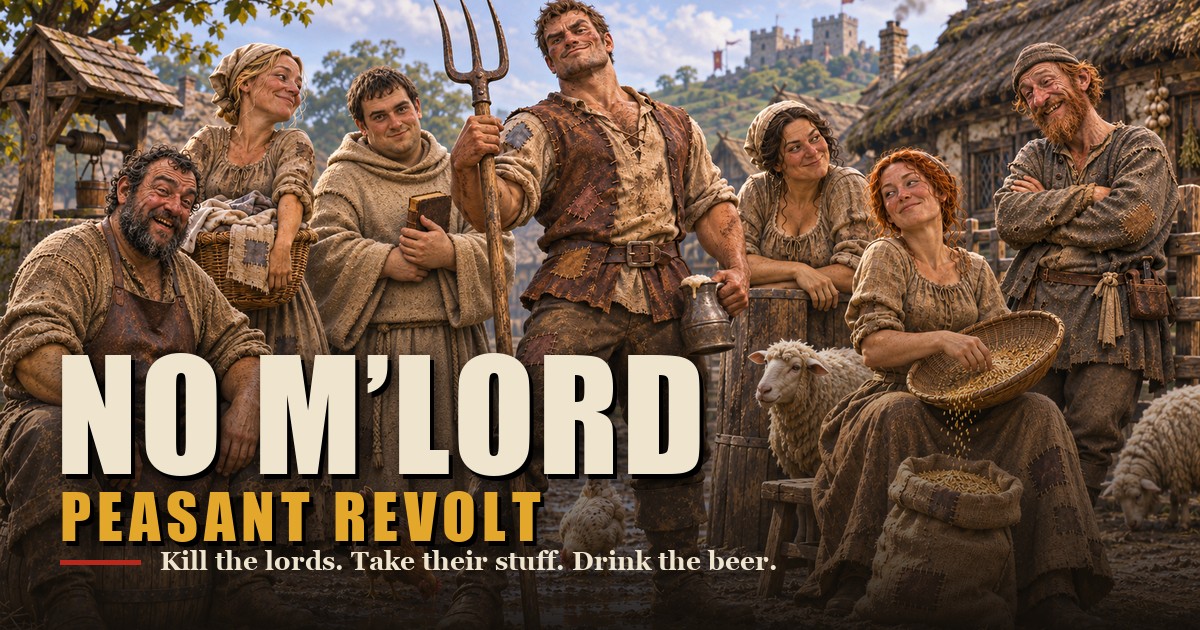
The director’s first words on it: a riff on Stronghold and real-time strategy in general, called No M’Lord: Peasant Uprising (it became Peasant Revolt on Saturday), built in Unreal Engine with coding agents and video cutscenes, and funny in the Blackadder way. A lord has decided everybody must go and fight over an insult at a drunken banquet. The village monk translates the Latin: you have to go and die for him because he says so. Everybody looks at everybody. Within half an hour the opening, the knockout and the first mission were all on the record.
The muster
The lord gives his lecture outside his own pathetic little fort while his horse rolls its eyes. The peasant says there’s something on his frock, points at his chest, and knocks him out with a pitchfork. He was the Rat first, then the Mouse, and ended up the Ferret.
Mission one
Not an army. Build the economy, keep the people happy, recruit monks. Enough monks and the attacking soldiers just switch sides.
The warning
The director told the crew up front that the game would live on its cutscenes and its mechanics, not on beautiful gameplay.
The idea that made it its own game
By Friday night he had put a name on it: the best of Stronghold and the best of Chivalry. The troops manage themselves, so there are no formations, no patrols, no selecting units, no move orders and no pathfinding chores; you run the village and the castle. When you are overwhelmed, the game drops into first-person hand-to-hand, where the enemy swings badly and you are a badass. You take a place by calling out its lord. You loot better weapons village by village, starting from sticks and pitchforks. It also happens to be exactly what the jam asked for: a Director’s Cut.
How the design grew
Friday
The insult, the muster and the knockout. Mission one as an economy of beer, people and monks. The Ferret’s map as a Risk-style board for picking the next village. Monks with kegs sneaking through gates. Beer as the measure of nearly everything, and three pillars: drink, money and persuasion.
Saturday
No epic battles: a place falls to a crowd at the gate or a duel with its lord. The rule of three, to keep it simple. The map drawn in code with home at the centre, and the interface drawn in code for good. A playable opening: the hut, the friends, the walk to the fort.
Sunday
Every scene on one village map, with the jam chapter ending at the church. Six friends round a wooden table. The beer that wins the Ferret’s soldiers over. Then the build went in, and the game went Windows-only.
Every one of those calls was logged the same day as a lettered Source in the game’s own record.
Act I
The machine
How one person directed a crew of AI agents to build a game in a weekend: in parallel, each in its own worktree, every branch merged back into one cut.
Scene 1
Twenty-eight branches, one cut
Agents worked in their own copies of the game on their own branches and merged back into main; Friday’s first sprint went straight down main. Below is every commit, drawn from the real git history.
Each strip is one day in Eastern time. Each row is a lane of parallel work; curves are branches leaving and merging back. Dots are commits, coloured by the model that signed the change; hover any dot for its message and time. Commits after the 8:59 PM deadline are faded. All commits share the director’s git identity; models are read from the signed changelog entry each commit added or its commit trailer, and branch names from merge messages. Scroll sideways on a phone.
Where the work came from
Show the branches
| Branch family | Who worked there | Branches | For example |
|---|---|---|---|
claude/* | Claude Code sessions, each in its own worktree | 12 | game opening rework, Mac build and test, HUD minimap |
codex/* | Codex sessions | 11 | localization schema, the Ferret, the Doberman rider, monk and soldier models |
worktree-wf_* | multi-agent workflow runs: several agents fanned out at once, then merged | 5 | three workflow runs, numbered -1, -2, -3 |
| Day | Commits | What it looked like |
|---|---|---|
| Fri 13 | 598 | the overnight sprint down main: gameplay systems written ahead of the first build |
| Sat 14 | 216 | parallel waves: up to eight lanes at once, merged and tested together |
| Sun 15 | 444 | worktrees merging hard all evening, then the build went in |
Three rules that made parallel work safe
- One worktree per Claude session. Each Claude Code session works in its own copy on its own branch and stays out of the main checkout, where other agents may be committing.
- Two writers avoid sharing a file. The build plan split packages so side-by-side work touched different files; shared lists like the cheat manager kept every block side by side.
- Merge up when done. Finished branches go into main and get pushed, so every agent reads the same documents next.
Scene 2
How the crew was run
The crew sheet
Show the whole crew
| Crew | Role on the production | On the record |
|---|---|---|
| The director | The vision, the canon and every cut. Plays the builds; never writes the code. | lettered Sources, A to BF |
| GPT-6.1 Terra | Lead gameplay engineer on the last days: chapter beats, cutscene wiring, trailer cuts | most frequent signature in the changelog |
| GPT-6.1 Codex | The first gameplay systems: settlement, livestock, monks, persuasion, riding, combat | 143 signed commits on day one |
| Claude Sonnet 5.5 | World builder: art imports, the village, people and animals, the board, the public wiki | 254 signed commits |
| Claude Opus 5.5 | Troubleshooter: skeletons, lighting, crashes, builds, the jam chapter | 93 signed commits |
| GPT-6 Luna | Localization lead: String Tables and 15 language catalogues | 15 locales, ready to ship |
| GPT-6.1 Sol and Claude Fable 5.2 | Story room and script supervisor: concept, scene book, gaps review, build plan | scene book, gaps review |
| Workflow crews | Fan-outs of parallel agents for one job, merged back as one | 5 workflow worktrees |
House rules
Show the house rules
| Rule | What it prevents | Evidence |
|---|---|---|
| One handbook for every assistant | Claude, GPT and Gemini drifting apart | AGENTS.md, 286 lines; CLAUDE.md only imports it |
| The director’s word logged as lettered Sources | agents inventing canon | lettered Sources, A to BF, each recorded the same day |
| Confirmed, Proposed, Open | guesses passing as decisions | the handbook sorts every decision into Confirmed, Proposed or Open; Open items get a recorded default in data |
| Every changelog entry signed with model and effort | untraceable work | over 1,000 entries across the weekend |
| “Verification” kept apart from “Not verified” | false claims of done | wave entries list both, every time |
| The director plays; agents never self-certify | agents grading their own homework | a master playtest list, numbered to 107 |
Scene 3
Parallel waves and quality gates
The call sheet
| Part | Packages | What it built |
|---|---|---|
| A | A1 to A7 | the shell: title, pause, settings, controls, HUD |
| B | B1 to B7 | the first chapter |
| C | C1 to C4 | bodies and motion |
| D | D1 to D9 | the rest of the design |
The waves
| Wave | In parallel | Passing after merge | Conflicts |
|---|---|---|---|
| 1 | 7 | 61 | — |
| 2 | 5 | 110 of 110 | cheat lists, kept side by side |
| 3 | 2 | 129 | cheat lists, kept side by side |
| 4 | 4 | 159 of 159 | cheat lists and shared headers, kept side by side |
| 5 | 2 | 172 of 172 | one, in the cheat manager |
Quality gates, in threes
Tests
- 335 automated tests in 62 files
- every package adds at least one
- the full suite runs headless after each wave
QA
- one shared queue instead of every agent building alone
- six tiers: static checks, build, tests, boot, cheats, shots
- one worker, one request at a time
Data
- 80 data files written into config by 52 Apply scripts
- each script checks its data before it writes
- a localization check on every push
Act II
The design
The jam chapter is a tutorial. Underneath it is a whole game, built to one director’s rules. Here is what the tutorial doesn’t show.
Scene 4
Everything comes in threes
The rule of three is the director’s guiding principle, and the point is simplicity. Castle games pile up resource chains by the dozen; this one must not.
A ladder
Three kinds, ordered poor to rich, that the player climbs by choosing to. The middle rung has to be a real choice, not just a step on the way.
A set
Three of a kind with no order and no tier: the three companions, the three sisters.
The three pillars
| Pillar | Tier 1 | Tier 2 | Tier 3 |
|---|---|---|---|
| Drink | beer | wine | moonshine |
| Money | bronze | silver | gold |
| Persuasion | monk | priest | bishop |
Every three in the game
Show every three
| The three | Kind | Held in |
|---|---|---|
| Farm, food and brew chains | ladders | data: each climbs rungs 1 to 3 (grain to corn, eggs to cheese, beer to moonshine) |
| Mounts: sheep, goat, horse | ladder | code check: the transport validator refuses anything but three |
| Carts: no wheels, stone wheels, wooden wheels | ladder | code check: same validator |
| Chapel, church, cathedral | ladder | data: they hold 2, 4 and 6 monks (the cathedral is defined; nothing builds it yet) |
| Monk, priest, bishop | ladder | data: persuasion ×1, ×1.5, ×2.25 |
| Taught tech: wood, stone and iron working | ladder | data: taught over 45, 60 and 75 seconds for 10, 20 and 30 gold |
| Duels of one, three or six a side | ladder | code check: any other size is rejected |
| Three monks round one man convert him | rule | data: three monks, 450 cm, no gap over 180°, 1.5 seconds |
| Companions: Ned, Ted and Fred | set | data: the speaker list |
| Sisters: Mary, Maria and Marla | set | data: the speaker list |
A rule of three that lives only in prose will be broken. So the important ones are enforced in code.
The crew audited the game against the rule
Fifteen places came out with the wrong count, from five tax levels and five foods to two wall tiers and thirteen untiered weapons. Each one is listed with a fix.
…and knew what not to touch
The director’s own numbers stay as he set them: five throwable vessels, four ways a place falls, seven pieces of armour. A rule serves the design; it doesn’t overrule the director.
Scene 5
The director’s rulebook
How you play
- Troops manage themselves. You never select, move, patrol or form up a unit; you run the place.
- Never an epic battle. A place falls one of four ways: a crowd at the gate, or a duel with its lord at one, three or six a side.
- Win by beer, not violence. A thrown keg makes soldiers drink, stop fighting and join you.
- Taking a village always pays. Its output doubles, triples or quadruples: rolled once, kept, never less.
- Starvation beats monks. Persuasion runs on happiness × recent food, so spamming monks can’t fix a hungry village.
What you see
- A glow, not health bars. Soldiers glow red against you and light to deep green for you.
- The route is always obvious. A worn path, a marked path or a glowing sign between every stop.
- Right hand fights, left hand carries. The tankard is your shield until you find a real one.
- No advisor, six friends. Ned, Ted, Fred, Mary, Maria and Marla give the notifications, with portraits, and sit round the wooden kingdom table, each with a job. Management is a few rough choices, never a wall of sliders.
How it’s made
- Nothing hard-coded. Villages, lords, links, prices and rates live in data: 80 files, 52 Apply scripts.
- Confirmed, Proposed, Open. Every design line says who decided it.
- Never invent canon. No made-up dialogue or drama; an unscripted moment gets a clean transition.
- The interface is code-drawn for good. Parchment, ink, wax seals and page curls are paint routines.
- Look before you make. Use the art you own before making anything new.
Scene 6
Below the waterline
Above the line: the 22 beats of the jam chapter, from waking in the hut to choosing a place on the map.
| System | What it does | Depth | Status |
|---|---|---|---|
| Economy | |||
| Settlement simulation | One service owns every stock count on a fixed 0.2-second step. Every change goes through one all-or-nothing transaction: no negative stock, ever. | 53 files | Built |
| Production chains | Brewing, farming and food each climb rungs one to three; every producer is a data record with a cycle, inputs and outputs. | 16 / 25 | Built |
| Livestock | Chickens, sheep and goats age with random spread and turn to meat when old. Laying eggs keeps the hen. | 3 kinds | Built |
| Popularity and chicken sacrifice | Popularity is built from standing terms like taxes and drink; sacrificing a chosen chicken buys a timed boost. | +10 drink | Built |
| Taxes, priorities, recruiting | Five tax levels from none to cruel, paid every 60-second cycle; production priority and recruit kinds as standing choices. | 0–7 coin | Built |
| Recruit-taught technology | Recruits teach wood, stone and iron working over time, unlocking the wooden-wheeled cart and more for good. | 3 techs | Built |
| The body | The peasant runs on fuel boxes filled by food; drink and injury each blur his sight along their own curve. | — | In chapter |
| Persuasion | |||
| Defection and the glow | Winning a soldier over is one atomic switch: his hostile AI stops, he changes side, the rosters update. | — | In chapter |
| Beer as a weapon | Kegs carried, thrown to splash, or set down as a lure that enemies drink from until they turn. | 40 files | In chapter |
| Monks, priests and bishops | Trained at chapel and church for bronze and beer; each tier persuades harder. The cathedral, and with it the bishop, is defined in data but not yet buildable. | ×1 / ×1.5 / ×2.25 | Built |
| Latin spells | Five Latin phrases as monk spells, from a recruiting toast to a cohesion break; two start undiscovered. | 5 spells | Built |
| Persuasion with cohesion | Monks hand soldiers beer from real stock; each nearby ally of the same lord makes a man harder to turn. | per ally | Built |
| Keg catapult | Lobs kegs into enemy ranks with double splash; switched off until it’s placed on the new village map. | 75 m | Off |
| War and campaign | |||
| First-person melee | Slash, stab, overhead, jab, kicks, bite, tackle; block, counter, riposte, parry, guard break, feint. | 9 / 9 | In chapter |
| The Ferret’s map | Painted in code with regions, rivers, roads and markings; a Risk-style board for choosing where the revolt goes next. | 11 places | In chapter |
| The kingdom table | Six friends round the map, each with a job. | 6 friends | In chapter |
| Mounts and carts | Sheep, goat and horse; carts with no wheels, stone wheels or wooden wheels. | 3 + 3 | In chapter |
| Self-managing troops | A troop director sends fighters at nearby enemies, sends monks to persuade, and brings everyone home. | — | Built |
| The overwhelmed switch | When pressure on home stays high, you drop into the fight beside your companions. No button, no menu. | — | Built |
| Calling out the lord | Duels staged from each lord’s record; the rest of the mission freezes; winning takes the place. | 10 lords | Built |
| Looted weapons | From the pitchfork and the threshing flail, one per place, up to the king’s castle weapon. | 18 in data | Built |
| Missions and briefings | Take, rescue and slay missions at named places, each enemy place with its own briefing screen. | 14 / 10 | Built |
| Checkpoints | Snapshots of the settlement, board, knowledge, persuasion and player, restored on restart. | 21 files | Built |
| Tower archers and the Doberman rider | Archers man the towers by themselves; a small rider on a Doberman. Both written and switched off for the jam chapter. | — | Off |
How a place falls
Show how a place falls
| Way | How it works | Lords |
|---|---|---|
| Duel, one a side | call out the lord and beat him | 3 |
| Duel, three a side | you and two friends against him and two knights | 5 |
| Duel, six a side | the big ones | 2 |
| A crowd at the gate | enough peasants hold at the gate and it gets opened | allowed for 3 lords |
Four ways, never an epic battle. On top of that, some castles fall without a fight: monks carry kegs in and open the gate from inside.
Act III
The director
A director earns the title in the cutting room, and on more than one stage at once.
Scene 7
The cutting room
| The call | What was cut or changed | Why |
|---|---|---|
| Cut the clip | The generated knockout clip was rejected outright. The smack became a beat in the game itself. | it looked like concept art, not the game |
| Cut the toy art | Free low-poly kits banned; the bought, realistic village and foliage packs used instead. | “look before you make”: never build what you own |
| One stage | Every scene moved onto one village map, measured once into data. | reopening the map wasted time and crashed the editor |
| One skeleton | Every body rebuilt onto one mannequin skeleton. | so every bought combat animation plays on everyone |
| Park localization | 15 languages built, then suspended in the last hours. | nothing may block the package |
| Switch off, don’t delete | The keg catapult and tower archers stay in code, off in data; the Doberman rider stays in code too, off for the jam chapter. | catapult and archers back on once they’re placed on the new map |
Everything is for the jam
There is no later phase. Plans put work in build order instead of parking it.
Easy first, harder later
The player wins nearly everything early; later places need several villages and a mob.
Nothing hard-coded
So every cut is a line of data, not a rewrite.
Scene 8
The ledger
Also: 80 data files, 52 Apply scripts, and a 37-page public game wiki.
Scene 9
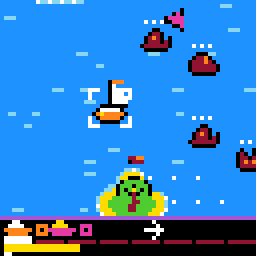
The other stage: teaching AI to play games it has never seen
Peasant Revolt was the weekend project. Right alongside it ran ARC-AGI-3: games no AI has seen before, with no instructions, where the agent has to work out the rules by playing. Same crew-directing job, a very different arena, and a top-five finish among thousands of teams.
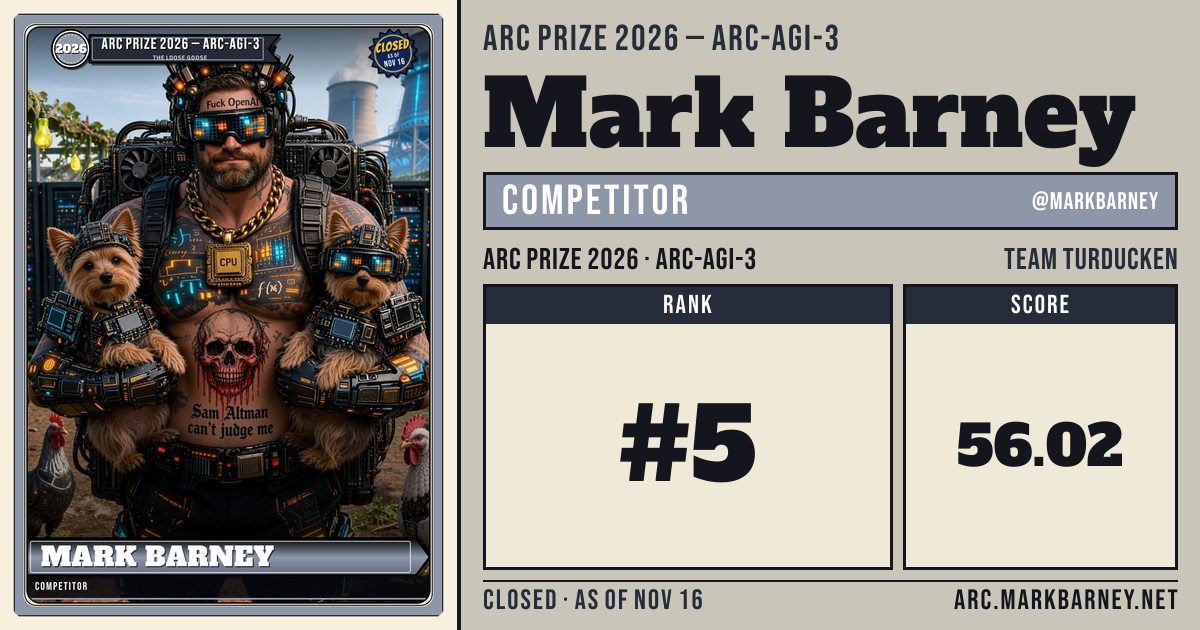 His competitor card in The Loose Goose, the sports tabloid of the Kaggleverse →
- ARC Prize 2026 · ARC-AGI-3. With Team Turducken: peaked 3rd of 4,330 teams, finished 5th of 4,923 on the final public leaderboard.
- Thanked by the ARC Prize Foundation in its 2025 results for his community contributions, including the ARC Explainer.
- Kaggle bronze medal: RSNA Knee Abnormality Detection, 412th of 6,299 teams.
- The Loose Goose: his tabloid of the ARC Prize season, with a card for every competitor.
The director’s eye: 1,046 games made, 46 kept
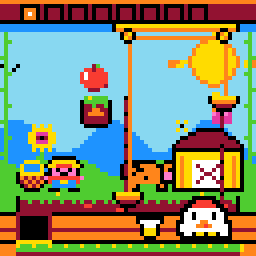
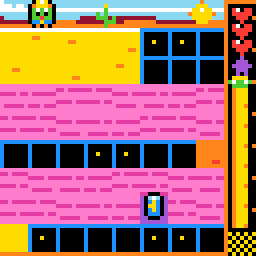
To teach an AI games it has never seen, you need a great many games nobody has seen. His team and their AI agents made 1,046 of them in ARC’s engine. Forty-six made the cut, and the cut was his: played, sent back with notes, played again, some through eight versions. The same job as Peasant Revolt, in a different medium. Play the synthetic games →
Now
Since the jam
The deadline was the starting gun. The week after it, the game has kept moving.
Windows, all the way
The jam build came from a Mac. Now the game is built, packaged and played on one Windows machine, with a single script that cooks and zips a release.
One animation system
Every character now stands on one mannequin skeleton and plays the bought Combat Master moves. Two systems became one, and every change got simpler.
A village with more life
Dogs roam the whole village, soldiers carry a mix of weapons, the opening no longer moves on a timer, and a parchment letter is ready for the new management layer.
A trailer, rebuilt
Cut, judged, and cut again, until it opened on Florian himself. It is at the top of this page.
Play version 0.2.1 free for Windows
0.2.1 is a test build. Some of the newest changes have not been played yet.